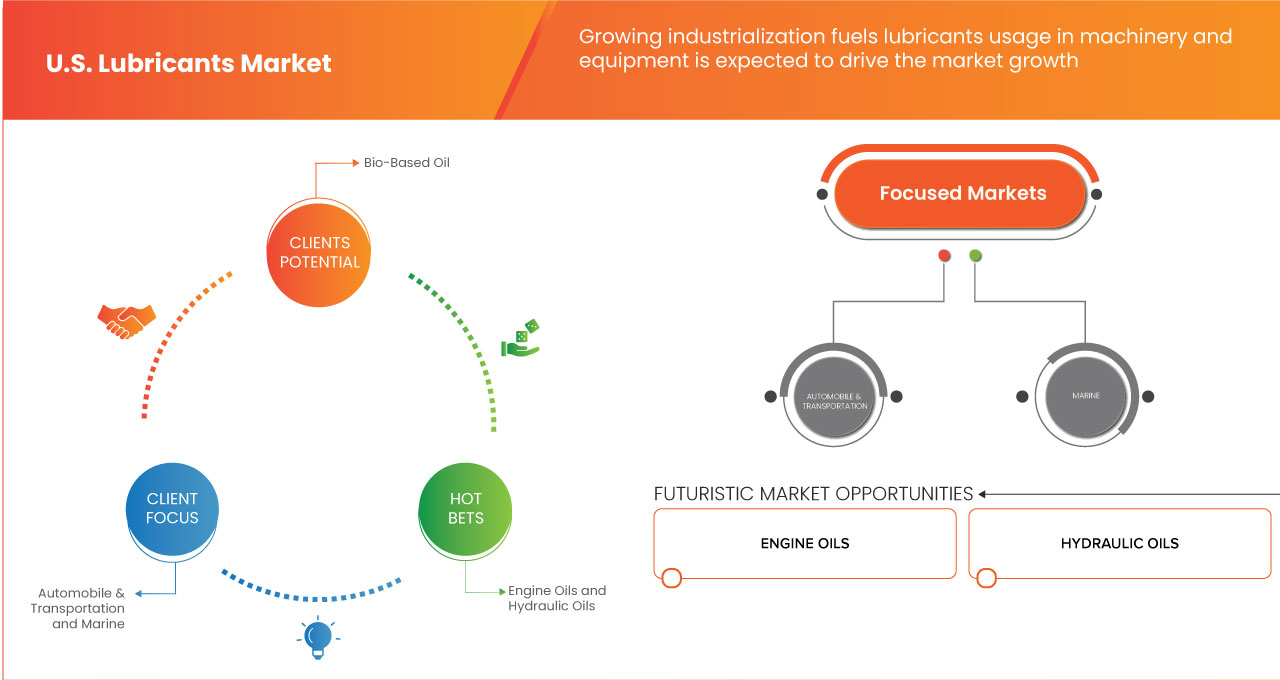
The complete U.S. Lubricant Market report is spread across a number of pages, list of tables & figures, profiling many companies. The major topics of this document can be listed as overview of U.S. Lubricant Market industry, Manufacturing cost structure analysis, Development and manufacturing plants analysis, Key figures of major manufacturers, Regional market analysis, Segment market analysis by type and by application, Major manufacturers analysis, Development trend analysis, Marketing channel, and Market dynamics. Market forecast section in the U.S. Lubricant Market analysis report is obsessed with production and production value forecasts and key producers forecasts by type, application, and region.
The U.S. Lubricant Market analysis report is a skillful and deep analysis of the present situation and challenges. This report focuses on the key drivers, restraints, market opportunities, threats, and risks for major market players. It also makes available analysis of market size, shares, growth, segmentation, revenue projection (USD Mn), and regional study till 2033. The market research document offers a comprehensive overview of the global U.S. Lubricant Market and contains thoughtful insights, facts, historical information, and statistically supported and industry-verified market data. It also encompasses forecasts using a suitable set of predictions and distinct research methodologies.
Stay ahead with crucial trends and expert analysis in the latest U.S. Lubricant Market report. Download now:
https://www.databridgemarketresearch.com/reports/us-lubricant-market
U.S. Lubricant Industry Overview
Segments
- Product Type: The U.S. lubricant market can be segmented based on product type into engine oil, transmission and hydraulic fluid, metalworking fluids, general industrial oils, gear oil, process oil, and others. Engine oil is expected to dominate the market share due to the high demand from automotive applications and industrial machinery.
- Base Oil: Segmentation based on base oil includes mineral oil, synthetic oil, bio-based oil, and others. Synthetic oils are gaining traction due to their superior properties such as thermal stability, viscosity index, and resistance to oxidation compared to mineral oils.
- End-Use Industry: The market can be segmented based on end-use industry into automotive, industrial, marine, and others. The automotive sector is a major consumer of lubricants due to the increasing number of vehicles on the road and the need for maintenance.
Market Players
- Exxon Mobil Corporation: A leading player in the U.S. lubricant market, offering a wide range of products for automotive and industrial applications.
- Chevron Corporation: Known for its high-quality lubricants catering to various industries, Chevron is a prominent player in the market.
- Royal Dutch Shell Plc: With a strong presence in the global lubricants market, Shell offers innovative products and solutions for diverse applications.
- BP Plc: BP is a key player in the U.S. lubricant market, providing lubricants for automotive, industrial, and marine sectors.
- Total S.A.: Total is a major player in the market, offering a comprehensive range of lubricants for different end-use industries.
The U.S. lubricant market is witnessing steady growth due to the increasing demand from various sectors such as automotive, industrial, and marine. The market is driven by technological advancements leading to the development of high-performance lubricants that enhance efficiency and prolong the life of machinery. Engine oil remains a key segment in the market, fueled by the rising automotive industry and the need for lubricants with advanced protection properties. Synthetic oils are gaining popularity due to their benefits over traditional mineral oils, such as better thermal stability and oxidation resistance.
The automotive sector dominates the end-use industry segment, driving the demand for lubricants in the U.S. market. With a growing number of vehicles on the road, the need for regular maintenance and lubrication has surged, propelling the market growth. Industrial applications of lubricants also play a significant role in the market, with industries relying on high-quality lubricants to ensure smooth operations and equipment longevity. The marine sector, although a smaller segment, contributes to the demand for specialized lubricants for marine engines and equipment.
Key market players such as Exxon Mobil Corporation, Chevron Corporation, Royal Dutch Shell Plc, BP Plc, and Total S.A. maintain a strong foothold in the U.S. lubricant market with their diverse product portfolios and extensive distribution networks. These companies invest heavily in research and development to introduce innovative lubricant solutions that meet the evolving needs of customers across different industries. Overall, the U.S. lubricant market is poised for growth driven by technological advancements, increasing industrial activities, and the expansion of the automotive sector.
The US lubricant market is experiencing a notable shift towards sustainable practices and environmentally friendly solutions. With a growing emphasis on reducing carbon footprint and meeting stringent regulatory standards, bio-based oils are emerging as a significant trend in the market. Bio-based lubricants, derived from renewable sources such as vegetable oils and animal fats, offer biodegradability, reduced toxicity, and improved lubricity compared to conventional petroleum-based lubricants. This trend is driven by the increasing awareness among end-users regarding the environmental impact of traditional lubricants and the need for eco-friendly alternatives.
Furthermore, the market is witnessing a rising demand for specialty lubricants tailored for specific applications and industries. Specialty lubricants offer enhanced performance characteristics, such as extreme temperature resistance, corrosion protection, and extended equipment life, making them ideal for critical operations in sectors like aerospace, manufacturing, and energy. Market players are focusing on developing customized lubricant solutions to cater to the diverse needs of these high-demand industries and gain a competitive edge in the market.
Additionally, digitalization and the adoption of Industry 4.0 technologies are reshaping the lubricant market landscape in the US. IoT-enabled lubrication systems, predictive maintenance tools, and data analytics platforms are revolutionizing the way lubricants are managed, monitored, and optimized in industrial settings. By leveraging real-time data and predictive algorithms, companies can improve equipment efficiency, prevent costly downtime, and optimize lubricant usage, leading to cost savings and increased operational performance.
Moreover, collaborations and strategic partnerships are becoming prevalent in the US lubricant market as companies seek to expand their product offerings, reach new customer segments, and enhance their competitive position. Joint ventures, mergers, and acquisitions are common strategies employed by market players to strengthen their market presence, broaden their geographic footprint, and tap into new growth opportunities. These partnerships enable companies to leverage each other's strengths, accelerate innovation, and achieve economies of scale in production and distribution.
In conclusion, the US lubricant market is undergoing significant transformations driven by sustainability trends, specialty product demand, digitalization initiatives, and strategic collaborations. By adapting to these evolving market dynamics and embracing innovation, companies can capitalize on emerging opportunities, mitigate risks, and stay ahead in the competitive landscape. As the industry continues to evolve, staying agile, customer-centric, and environmentally conscious will be key success factors for lubricant manufacturers and suppliers in the US market.The U.S. lubricant market is currently experiencing a notable shift towards sustainability and environmentally friendly solutions, driven by the increasing focus on reducing carbon footprint and meeting stringent regulatory standards. The emergence of bio-based oils as a significant trend in the market underscores the growing demand for biodegradable, less toxic lubricants derived from renewable sources like vegetable oils and animal fats. These bio-based lubricants offer enhanced lubricity and environmental benefits compared to traditional petroleum-based counterparts, appealing to end-users looking for eco-friendly alternatives. This shift towards sustainability aligns with the broader global trend towards greener practices and underscores the importance of environmental consciousness in the lubricant industry.
Moreover, the market is witnessing a rising demand for specialty lubricants tailored for specific applications and industries, such as aerospace, manufacturing, and energy sectors. Specialty lubricants offer advanced performance characteristics like extreme temperature resistance, corrosion protection, and prolonged equipment life, making them essential for critical operations in these high-demand industries. Market players are focusing on developing customized lubricant solutions to address the unique needs of these sectors, highlighting the growing importance of specialization and innovation in the market. This trend towards specialized lubricants reflects the evolving requirements of industrial applications and underscores the value of providing tailored solutions to meet customer demands effectively.
Furthermore, digitalization and the adoption of Industry 4.0 technologies are reshaping the landscape of the U.S. lubricant market. The integration of IoT-enabled lubrication systems, predictive maintenance tools, and data analytics platforms is revolutionizing how lubricants are managed, monitored, and optimized in industrial settings. By leveraging real-time data and predictive algorithms, companies can enhance equipment efficiency, prevent downtime, and optimize lubricant usage, leading to cost savings and improved operational performance. The embrace of digital solutions in lubricant management represents a significant shift towards automation, efficiency, and predictive maintenance strategies in the industry, highlighting the growing importance of technology in driving operational excellence and competitiveness.
Collaborations and strategic partnerships are becoming increasingly prevalent in the U.S. lubricant market as companies seek to expand their product offerings, reach new customer segments, and enhance their competitive position. Through joint ventures, mergers, and acquisitions, market players can strengthen their foothold in the market, broaden their geographical reach, and explore new growth opportunities. These strategic partnerships enable companies to leverage synergies, drive innovation, and achieve economies of scale in production and distribution, emphasizing the value of collaboration in a competitive market landscape. By forging strong partnerships and alliances, lubricant manufacturers can enhance their capabilities, access new markets, and drive sustainable growth in the evolving industry landscape.
Access detailed insights into the company’s market position
https://www.databridgemarketresearch.com/reports/us-lubricant-market/companies
Alternative Research Questions for Global U.S. Lubricant Market Analysis
- What is the current valuation of the global U.S. Lubricant Market?
- What CAGR is projected for the U.S. Lubricant Market over the forecast period?
- What are the key segments analyzed in the U.S. Lubricant Market report?
- Which companies dominate the U.S. Lubricant Market landscape?
- What geographic data is covered in the U.S. Lubricant Market analysis?
- Who are the leading firms operating in the U.S. Lubricant Market?
Browse More Reports:
Global Sustainable Finance Market
Global 3D Sensor Market
Global 72” Paint Protection Film Market
Global Acquired Neuromyotonia Treatment Market
Global Advanced Malware Protection Market
Global Aerial Photogrammetry Software Market
Global Aircraft Lighting Market
Global Aircraft Pushback Tugs Market
Global Anaplastic Astrocytoma Market
Global Arachidonic Acid Market
Global Automotive Air Flow Meter Market
Global Automotive Chromium Finishing Market
Global Aviation Blockchain Market
Global Baby Drink Market
Global Barbeque Grill Market
Global Bicycle Apparel and Accessories Market
Global Bruton's Tyrosine Kinase (BKT) Market
Global Cannabidiol (CBD) Gummies Market
Global Capnography Device Market
Global Cardiovascular Prosthetic Devices Market
About Data Bridge Market Research:
An absolute way to forecast what the future holds is to comprehend the trend today!
Data Bridge Market Research set forth itself as an unconventional and neoteric market research and consulting firm with an unparalleled level of resilience and integrated approaches. We are determined to unearth the best market opportunities and foster efficient information for your business to thrive in the market. Data Bridge endeavors to provide appropriate solutions to the complex business challenges and initiates an effortless decision-making process. Data Bridge is an aftermath of sheer wisdom and experience which was formulated and framed in the year 2015 in Pune.
Contact Us:
Data Bridge Market Research
US: +1 614 591 3140
UK: +44 845 154 9652
APAC : +653 1251 975
Email:- [email protected]